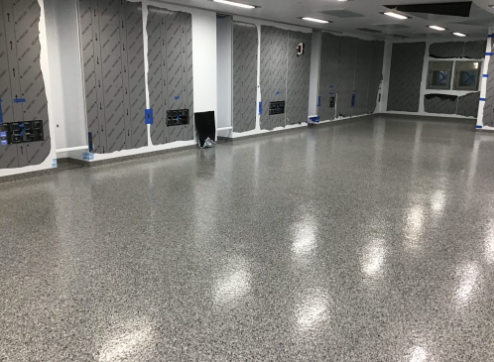

Warm tires can leave behind more than dirt after a car pulls into the garage. Certain rubber compounds can interact with weak floor coatings, causing dark marks, soft spots, staining, or loss of adhesion over time. A well-built epoxy flooring system reduces that risk through proper concrete preparation, compatible resins, controlled curing, and a protective topcoat designed for vehicle traffic.
Why Do Hot Tires Affect Garage Floor Coatings?
Tires contain plasticizers and other compounds that help rubber stay flexible during driving. Heat builds inside the tire as it rolls, and that warmth can increase the transfer of those compounds onto the floor once the vehicle is parked.
Pressure makes the effect stronger because each tire places concentrated weight on a small area. Softer coatings may absorb transferred material or react with it, leaving brownish marks or sections that feel slightly tacky. Homeowners searching for an epoxy garage floor near me should therefore ask whether the complete system is intended for regular vehicle parking rather than assuming any decorative coating can handle hot tires.
A Dense, Fully Cured Resin Limits Chemical Interaction
Quality epoxy becomes hard and chemically resistant after its resin and hardener react completely. Correct mixing ratios matter because poorly blended material can leave softer areas that are more likely to react with tire compounds.
Curing conditions also affect the finished surface. Cold temperatures can slow the reaction, while early vehicle traffic may place pressure on epoxy before it reaches full strength. Professional epoxy floor companies follow the coating manufacturer’s cure schedule and account for slab temperature, air temperature, and humidity before allowing cars back onto the floor.
Strong Concrete Adhesion Keeps Tires From Pulling the Coating Loose
Hot-tire pickup is not always a chemical problem alone. Rubber can grip the coating as it cools, then pull against weakly bonded material when the vehicle moves again.
Mechanical preparation gives epoxy a stronger hold on the slab. Diamond grinding removes smooth cement paste, old sealers, and surface contamination while creating small grooves and pores for the resin to enter. Properly prepared epoxy floors are less likely to lift because the coating has formed a physical bond with sound concrete underneath.
Protective Topcoats Take the First Hit From Tire Traffic
A durable topcoat creates another barrier between vehicle tires and the epoxy base. Polyaspartic and polyurethane finishes are often selected because suitable formulations can offer strong resistance to abrasion, chemicals, and heat generated by normal garage use.
Clear layers also protect decorative flakes and color from constant rubbing along parking paths. Instead of letting tires contact the main epoxy layer directly, the topcoat takes the everyday wear from road grit, turning wheels, and rubber transfer. People comparing epoxy floors near me should ask what material forms the final wear surface and how many coats the proposed system includes.
Surface Cleanliness Prevents Weak Spots Under Parked Vehicles
Oil, silicone tire dressing, grease, wax, and old cleaning products can remain inside concrete pores. Those contaminants may prevent epoxy from bonding properly, creating isolated weak areas that begin peeling under tires.
Detailed preparation removes more than visible dirt. Contractors may use degreasers, mechanical grinding, vacuum extraction, and additional treatment where automotive fluids have soaked into the slab. Searches for epoxy flooring near me should lead to installers who inspect old parking spots closely, since those areas often carry the highest concentration of oil and rubber residue.
System Thickness Helps the Floor Handle Repeated Tire Pressure
Thin coatings provide less material to absorb abrasion and repeated loading. A properly designed garage system uses enough build to protect the concrete without applying resin so heavily that curing problems develop.
Layered construction usually performs better than relying on one thick coat. Primer supports adhesion, the body layer provides strength and color, decorative material can add texture, and the topcoat protects everything underneath. Commercial epoxy flooring uses the same basic idea, although service bays and vehicle facilities may require heavier builds because tires cross the floor far more often.
Can Maintenance Reduce Plasticizer Marks and Tire Wear?
Routine cleaning prevents rubber residue, road oils, and abrasive grit from accumulating on the surface. Mild cleaners and soft-bristle tools are generally better choices than aggressive solvents that may damage the finish.
Prompt attention also makes tire marks easier to address. Fresh residue can be simpler to remove than material allowed to sit through repeated heating and cooling cycles. Harsh scraping should be avoided because scratches can make future dirt and rubber transfer more noticeable.
Ventilation can help garage temperatures stay more moderate during warm weather as well. Although the floor system should be designed for vehicle use, reducing excessive heat and keeping parking areas clean supports longer surface life.
The Full Flooring System Determines Tire Resistance
No single ingredient makes a garage floor resistant to plasticizers. Performance comes from the combined effect of concrete preparation, resin quality, accurate mixing, correct thickness, full curing, and a wear-resistant topcoat.
Elite Coastal Epoxy installs high-performance residential and commercial concrete finishes designed around the conditions each floor will face. Their team can evaluate vehicle traffic, existing concrete, contamination, and expected wear before recommending an epoxy flooring system built to resist tire-related staining, abrasion, and adhesion problems.